
Back to Knowledge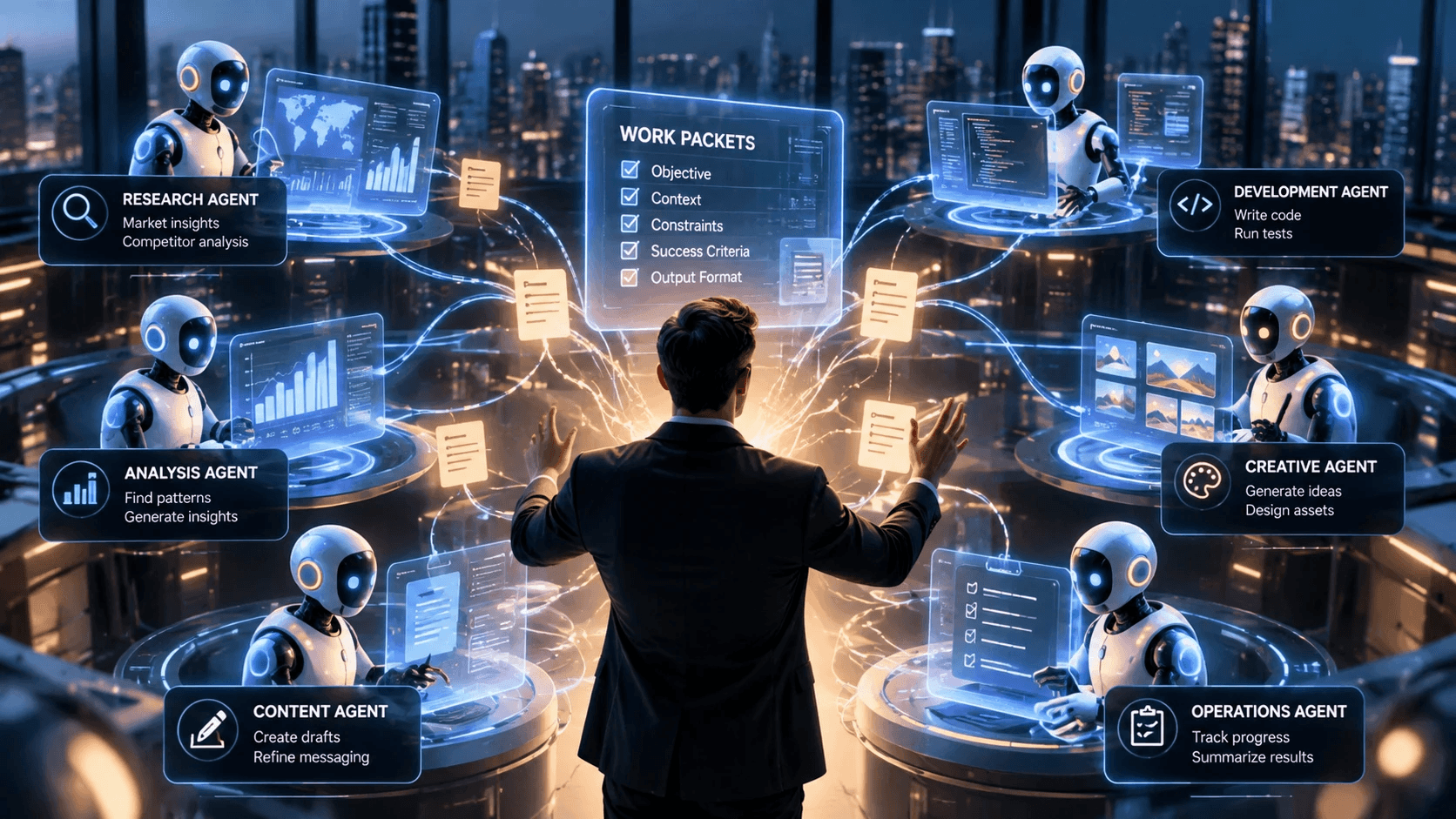
AI
Sep 16, 20265 min read
From People Managers to AI Managers
AI agents don't need motivation, praise, or promotions — they need clarity. As managers start orchestrating swarms of specialized agents, the core leadership skill shifts from managing capacity to designing intelligence: turning an ambiguous goal into a work packet another intelligence can execute exceptionally well.
The strangest thing about managing AI agents is that they do not need motivation, praise, promotions, or a better chair. They need something harder to provide: clarity. The manager of the future may spend less time asking, “How is your team doing?” and far more time asking, “Did I define the work well enough for intelligence to execute it?”
For decades, management was built around coordinating human beings. A manager assigned responsibilities, clarified priorities, resolved conflicts, coached performance, and tried to keep everyone moving in the same direction. That model made sense because human attention was scarce, expertise was distributed, and execution depended on people. AI changes the equation. When one person can delegate research to one agent, analysis to another, writing to a third, and synthesis to a fourth, the bottleneck is no longer how many people you can manage. It is how intelligently you can design the system.
That creates a subtle psychological shift. Delegation used to mean giving part of your workload to another person. Delegating to an AI agent is closer to designing a small autonomous operation. You are not simply saying, “Can you do this?” You are defining the objective, the boundaries, the available context, the expected output, and the conditions under which the work should come back to you. The quality of the result often depends less on the raw intelligence of the agent than on the quality of the work packet you hand it.
Think about a product manager preparing for a launch. In the old model, she might ask three people to research competitors, analyze customer feedback, and prepare a market summary. In the AI-native model, she could create three specialized agents with distinct work packets: one analyzes competitor positioning, another clusters thousands of customer comments, and another identifies market signals from recent announcements and public data. A fourth agent could then receive those outputs and produce a decision brief. The manager is no longer simply coordinating people. She is orchestrating intelligence.
This is where the idea of an AI swarm becomes interesting. A swarm is not just a collection of agents. It is a system in which specialized agents perform interconnected pieces of work, sometimes sequentially and sometimes in parallel. Imagine an engineering leader who has agents monitoring code quality, reviewing pull requests, analyzing production incidents, generating test cases, and documenting architecture changes. None of these agents replaces the leader. Instead, they expand the leader's span of attention.
But there is a trap here. More agents do not automatically create more productivity. A badly designed swarm can become an organizational junk drawer, full of autonomous systems producing plausible work that nobody has time to inspect. The psychological danger is familiar: activity feels like progress. Managers may become impressed by the volume of outputs while losing sight of whether those outputs actually move the business forward.
That is why defining work packets becomes a core leadership skill. A good work packet answers questions that traditional delegation often leaves implicit. What exactly is the objective? What information should the agent use? What should it ignore? What does a useful answer look like? What constraints matter? When should the agent stop? When should it escalate? What decisions remain human-only?
Consider a sales leader who tells an agent, “Find some promising accounts.” That sounds simple, but it is not. A stronger work packet might specify the target industry, company size, geographic market, recent hiring signals, technology footprint, buying indicators, exclusion criteria, and the format in which opportunities should be returned. The difference is not clever prompting. It is managerial thinking made explicit.
There is another psychological shift hiding underneath all of this. Humans often resist delegation because delegation feels like loss of control. With AI, the opposite can happen. Because an agent can produce work almost instantly, managers may be tempted to interfere constantly, rewriting instructions, checking every intermediate step, and manually correcting outputs. That creates the AI equivalent of micromanagement. The manager becomes the bottleneck again.
The better question is not, “How do I control every agent?” It is, “What architecture allows me to control the important outcomes without controlling every action?” That distinction may become one of the defining principles of AI-era leadership.
A future marketing leader, for example, might have an agent researching audience behavior, another generating creative hypotheses, another testing messaging against historical campaign data, and another preparing performance summaries. The leader does not need to inspect every piece of generated copy. She needs visibility into assumptions, quality thresholds, exceptions, and business outcomes. Her job becomes setting the operating system for the intelligence around her.
This changes what leadership itself means. Traditional management rewarded coordination, availability, communication, and institutional knowledge. Those skills will still matter, but their relative importance may shift. Leaders will increasingly need to design systems, decompose ambiguous problems, define interfaces between agents, establish feedback loops, and decide where human judgment is irreplaceable.
The irony is that AI may make great management more human, not less.
When machines handle more of the repetitive coordination and analytical workload, leaders have more room for the parts of leadership that cannot be reduced to a work packet: judgment, trust, courage, context, ethical responsibility, and the ability to understand what people are actually experiencing.
The manager of the future may therefore look less like a supervisor standing above a hierarchy and more like an architect standing inside an intelligence network. She will decide which work should be automated, which should be delegated, which should be challenged, and which should remain deeply human. Her advantage will not come from having the most agents. It will come from knowing what each agent should be trusted to do.
That is the real transition from people managers to AI managers. It is not about replacing the org chart with a swarm of machines. It is about moving from managing capacity to designing intelligence. And once that happens, the most valuable managerial skill may become surprisingly simple: knowing how to turn an ambiguous goal into a piece of work that another intelligence can execute exceptionally well.
What would change in your role if you suddenly had ten capable AI agents working alongside you tomorrow? Would you give them your current task list, or would you redesign the work itself? I would love to hear where you think the biggest leadership shift will happen.