
Back to Knowledge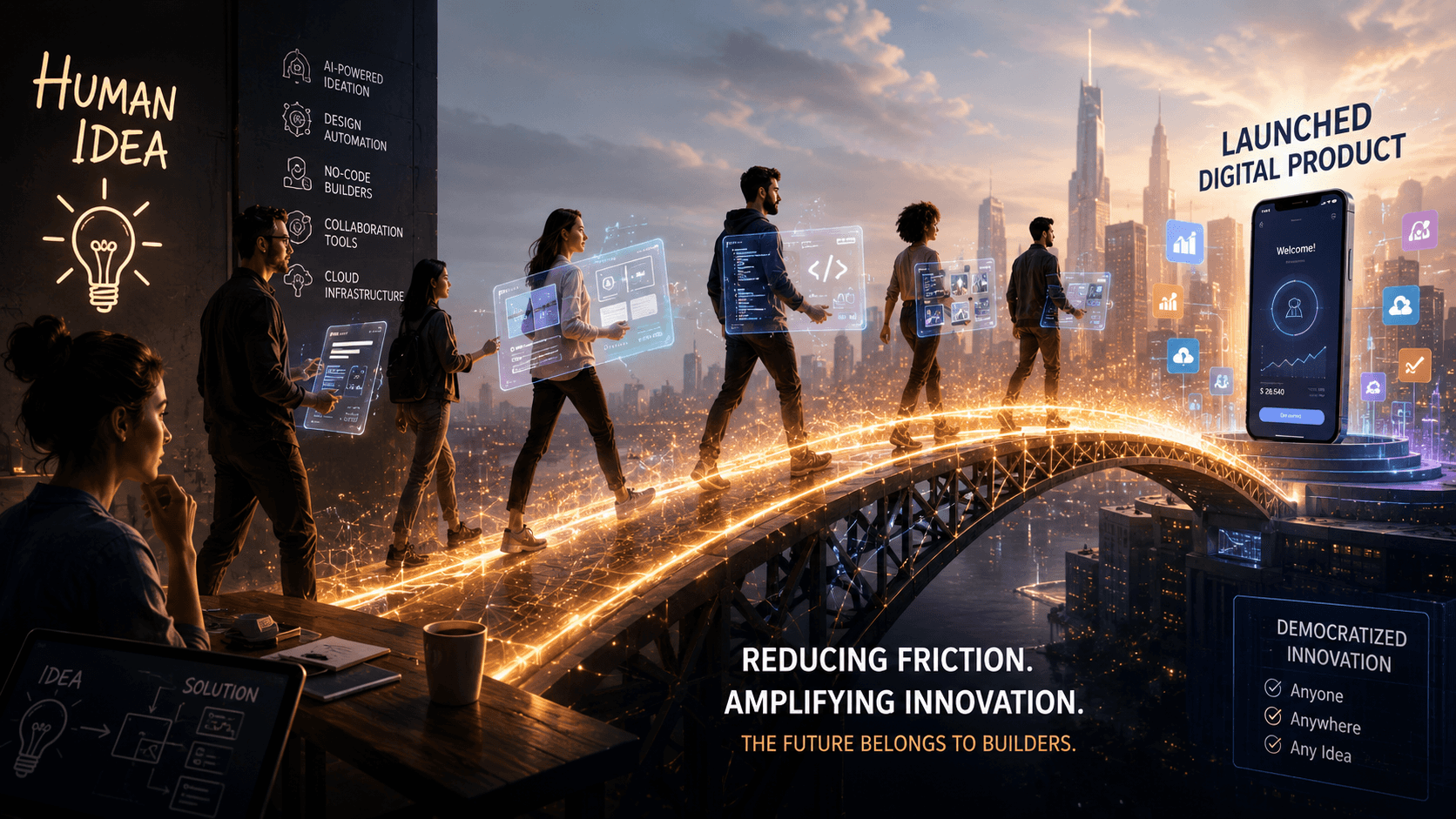
AI
Jul 20, 20265 min read
The Gap Between 'I Have an Idea' and 'I Shipped It' Has Collapsed
For decades, an idea and a shipped product were separated by a painful canyon of skill, capital, time, and permission. AI is quietly collapsing that gap — and the new bottleneck is no longer technical capability. It's decisiveness.
A strange thing is happening right now, and most people still haven't emotionally caught up to it.
For decades, having an idea and building something from that idea were separated by a painful canyon. You needed technical skill, capital, time, permission, confidence, and usually a small tolerance for humiliation. There was always a gatekeeper somewhere in the chain. A developer who was too expensive. A tool too complicated. A learning curve steep enough to make you quietly abandon the thing at 11:47 p.m. while pretending you would “come back to it later.”
Now the canyon is disappearing.
Not theoretically. Practically. Quietly. Fast.
A founder in Bangalore prototypes a customer onboarding tool during a layover using AI-generated code and launches it before boarding. A fitness coach in Toronto builds a nutrition tracking app without ever opening a computer science textbook. A designer with no backend experience creates an internal workflow automation that saves her company twenty hours a week, mostly because she stopped asking, “Am I technical enough?” and started asking, “What problem am I obsessed enough to solve?”
That shift matters more than people realize.
For years, we treated software development like architecture. Heavy. Formal. Slow. You drafted plans, assembled specialists, secured resources, and only then were you allowed to build. AI is turning parts of software creation into conversation. The interface is no longer syntax alone. It is intent.
And intent scales differently than expertise.
You can feel the psychological impact of this everywhere. People who spent years sitting on ideas are suddenly moving with unsettling speed. Not because they became engineers overnight, but because the distance between thought and execution has compressed so dramatically that hesitation itself is starting to look irrational.
That's the part nobody talks about enough.
Technology changes behavior long before it changes identity. At first, people still carry the emotional scars of the old world. They assume building must remain painful because it used to be painful. They still approach creation with inherited caution. You know that moment when someone says, “I've had this idea for years,” almost proudly? A few years ago, that sentence implied patience or ambition. Increasingly, it sounds like latency.
Because the new bottleneck is no longer technical capability.
It's decisiveness.
AI has quietly exposed something uncomfortable: many people were never blocked by intelligence. They were blocked by friction. By the exhausting ceremony around creation. By the invisible tax of translating imagination into systems. Writing boilerplate code, debugging tiny syntax errors, hunting through documentation, configuring environments, watching tutorials at 1.5x speed while wondering whether they were secretly falling behind everyone else.
Most ambition dies in the gap between energy and momentum.
AI compresses that gap.
A product manager can now test five landing page concepts before lunch. A teenager can build a Chrome extension over a weekend because the machine explains the errors while generating the fix. A small startup can run experiments that previously required an entire engineering sprint. The cost of trying has collapsed so aggressively that experimentation itself is becoming a competitive advantage.
And experimentation changes people.
When the cost of failure drops, human courage rises.
That sentence sounds simple, but it explains almost everything happening in technology right now.
The old world rewarded precision before action. The new world rewards motion before mastery. People used to study for months before attempting something public. Now they learn by shipping into the open. The rhythm has changed from “learn, then build” to “build, then learn.” That reversal is psychologically profound because it rewires the relationship between competence and confidence.
Confidence used to come from preparation.
Now it increasingly comes from responsiveness.
Can you adapt quickly? Can you iterate publicly? Can you recover from imperfect first versions faster than others can polish perfect drafts they never release?
That's why the internet suddenly feels noisier and more alive at the same time. We are watching millions of people gain operational leverage simultaneously. Not elite engineers alone. Teachers. Analysts. Writers. Solopreneurs. Operations managers. College students with dangerous levels of curiosity and no patience for permission structures.
Of course, some people hate this shift. They argue that lowering technical barriers lowers quality. Sometimes they are right. The internet will absolutely be flooded with mediocre products, lazy clones, shallow automation, and AI-generated sludge masquerading as innovation.
But history suggests something important: democratization always looks messy in the beginning.
When cameras became cheap, people complained about amateur photography. When publishing became digital, critics feared the collapse of serious writing. When video creation became accessible, professionals mocked creators filming on phones. Yet every wave of accessibility eventually produced extraordinary new voices because talent was no longer filtered exclusively through institutional access.
We are entering that phase for software.
The next generation of impactful products will not come only from people who spent ten years mastering infrastructure. Many will come from people who understand lived problems deeply enough to direct machines toward solving them. Domain expertise is starting to matter as much as technical expertise. Sometimes more.
A nurse who understands patient frustration can now prototype healthcare workflows. A recruiter can build internal hiring tools. A restaurant owner can automate reservation systems tailored to actual customer behavior instead of adapting to generic software built by distant teams.
The people closest to the pain are finally closer to the solution layer.
That changes markets. But it also changes identity.
For years, millions of people quietly categorized themselves as “non-technical.” It became a permanent psychological label, almost like a caste system inside modern work. You were either one of the builders or one of the people asking builders for help.
AI is destabilizing that distinction.
Not completely. Deep engineering still matters enormously. Infrastructure matters. Systems thinking matters. The best technical minds will become even more valuable as complexity scales upward. But the threshold for participation has dropped hard enough that millions of people are walking through the door for the first time.
And once someone ships one thing, something irreversible tends to happen.
They stop seeing technology as sacred.
They stop treating creation as something reserved for specialists.
They realize the modern economy increasingly rewards people who can turn vague intuition into functioning systems quickly. Even imperfectly.
Especially imperfectly.
Because perfection is often just fear wearing expensive clothes.
The people who thrive in this next era will not necessarily be the loudest or the most credentialed. They will be the ones willing to compress the cycle between curiosity and execution. Idea. Prototype. Feedback. Iteration. Repeat. Fast enough that momentum compounds before self-doubt catches up.
We are watching the emergence of a new creative class. Not defined by coding purity, but by agency.
And agency scales.
So I'm curious: what's something you would build right now if you stopped assuming you needed permission, credentials, or technical mastery first?