
Back to Knowledge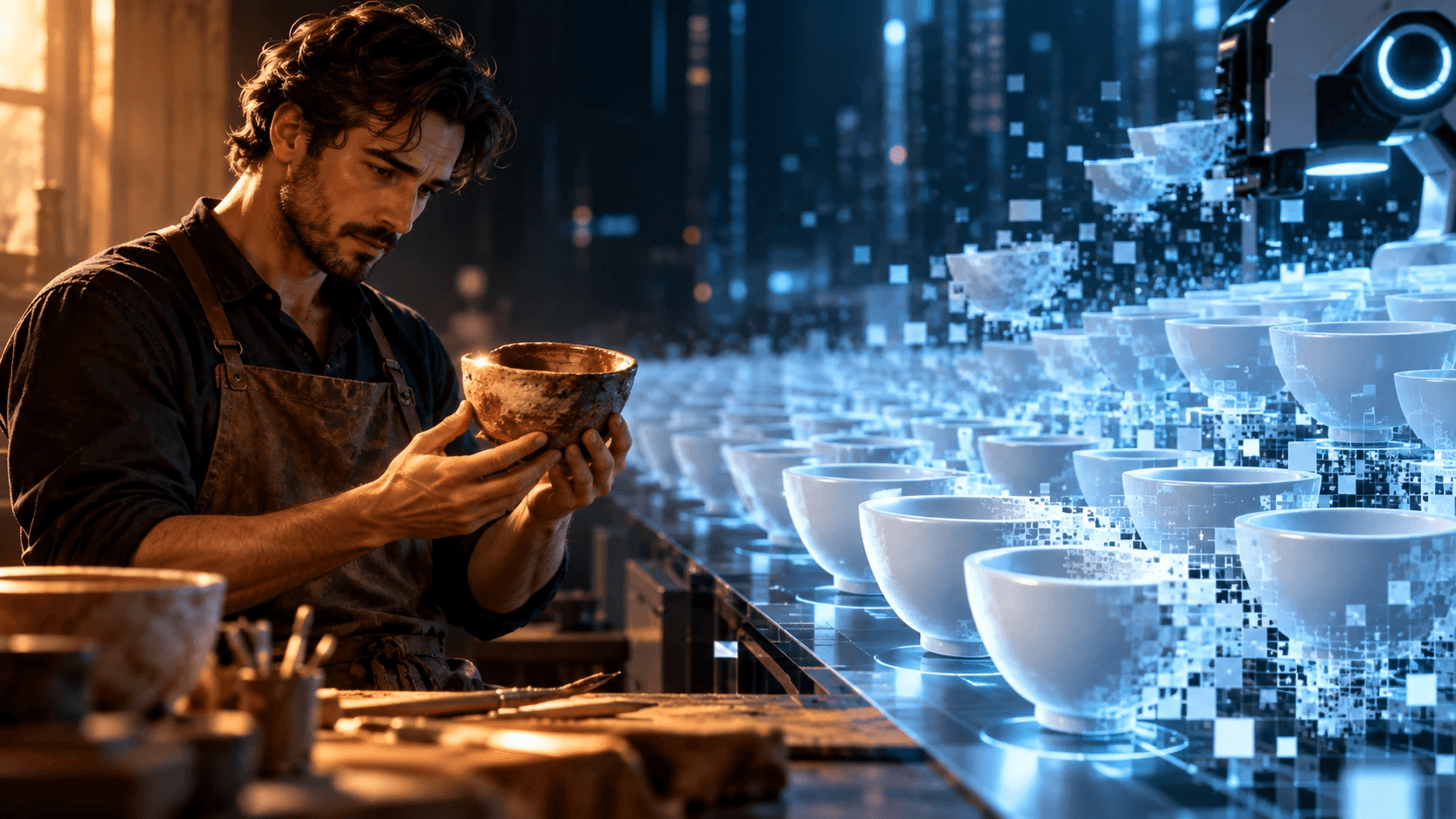
AI
Sep 14, 20265 min read
There’s No Emotional Attachment to AI-Generated Work
When the easiest way to repair a creation is to throw it away and regenerate it, our relationship with the things we make starts to change. Ownership is shifting from “I made this” to “I can produce this” — and the scarce resource may no longer be the ability to create, but the ability to care.
Have you ever deleted an hour of work in ten seconds because you knew you could recreate it with AI? That tiny moment feels harmless, almost efficient. But something much bigger is happening underneath it: we are changing our relationship with the things we make.
I noticed it first in code. An engineer spends twenty minutes wrestling with a bug, finally understands the problem, changes three lines, and moves on. Then an AI-generated implementation arrives that is 200 lines long, mostly works, and fails in an interesting corner case. Instead of fixing it, the engineer asks the model to rewrite the whole thing. Five minutes later, there is another 200 lines. The problem is gone, technically. So is the emotional connection to the code.
That distinction matters more than it sounds. When you struggle to build something, the struggle becomes part of your understanding. You remember why the ugly function exists. You know which shortcut almost broke production. You can point at a strange line six months later and remember the afternoon you spent figuring it out. The artifact is not merely an output. It carries evidence of your effort.
AI changes that equation because it dramatically reduces the cost of replacement. If a paragraph is mediocre, regenerate it. If the design feels wrong, regenerate it. If the code is messy, regenerate it. If the strategy document needs a different structure, regenerate the entire thing. We have entered an era where the easiest way to repair a creation is often to throw it away.
That creates what I think of as disposable work.
Disposable code is code nobody feels compelled to understand because it was cheap to produce. Disposable creativity is an image, article, presentation, song, or idea that can be regenerated faster than it can be emotionally defended. And once the cost of creation approaches zero, our psychology begins to treat the creation differently.
This is where craftsmanship gets uncomfortable.
Craft has always contained a strange psychological bargain. You invest yourself into something, and in return the thing starts to feel like yours. A designer can spend three hours adjusting a single visual detail and become disproportionately attached to it. A writer can fight with one paragraph for an entire morning and then defend those six sentences as if they were a small piece of personal history. A programmer can spend two days understanding a system and become protective of its architecture because they now understand what it took to make it work.
AI can interrupt that loop.
Imagine two engineers maintaining the same application. One wrote most of the original system manually. The other inherited an AI-generated codebase and has been prompting their way through it for six months. When both encounter a difficult module, their behavior may be radically different. The first engineer may think, “There has to be a reason this works this way.” The second may think, “Why spend an hour understanding this when I can generate a replacement?”
Neither person is necessarily more capable. Their relationship with the artifact is different.
Ownership psychology is shifting from “I made this” toward “I can produce this.” That sounds like a small linguistic change, but it has enormous consequences. The first identity creates attachment, responsibility, memory, and sometimes pride. The second creates flexibility, speed, and detachment. We gain the ability to move faster, but we may lose some of the psychological friction that made us care.
And friction is not always the enemy.
Some of our best work emerges because we cannot instantly escape the difficult part. You sit with the problem because starting over would be painful. You keep editing because you have already invested three hours. You investigate the strange bug because you know the system intimately enough to suspect something deeper. The sunk cost can be irrational, but sometimes it is also the force that keeps you engaged long enough to develop mastery.
AI removes that force with extraordinary efficiency.
A writer who generates fifty introductions may become less attached to any one of them. A product manager who can instantly generate twenty strategies may feel less compelled to deeply interrogate the first one. A developer who can regenerate an entire feature may never develop the same intimacy with the underlying system. The paradox is that abundance can weaken attention.
There is another psychological shift hiding here: identity.
For generations, craftsmanship gave people a story about themselves. “I am a programmer.” “I am a photographer.” “I am a writer.” “I am a designer.” The work was evidence of the identity. You became the kind of person who could make difficult things.
Now imagine producing something exceptional without being able to explain exactly how you produced it. The artifact is impressive, but the path to it feels strangely hollow. You know what you asked for. You know what you selected. You know what you rejected. But somewhere inside, there is a quiet question: did I make this, or did I merely recognize the version I wanted?
That question will become increasingly important.
The answer is not to romanticize manual work or pretend AI should not be used. That would miss the point entirely. The interesting challenge is to decide what deserves attachment in a world where production is cheap.
Maybe the future of craftsmanship is not about refusing AI. Maybe it is about choosing where to care.
Use AI to generate the hundred variations, but know why you chose the final one. Let AI write the first draft, but become responsible for the argument. Let it produce the implementation, but understand the architecture you are willing to maintain. Let the machine remove mechanical effort without allowing it to remove your relationship with the outcome.
Because the scarce resource may no longer be the ability to create.
It may be the ability to care about what we create.
And that could become one of the strangest consequences of the AI era. We may enter a world overflowing with extraordinary work, while fewer people feel that any of it belongs to them.
The question I keep coming back to is simple: when AI makes creation disposable, what will make us care enough to finish something, defend it, understand it, and call it ours?
I’d love to hear how this is showing up in your work. Are you finding yourself more willing to rewrite, regenerate, and replace things you once would have fought to fix? Tell me what you’ve noticed.