
Back to Knowledge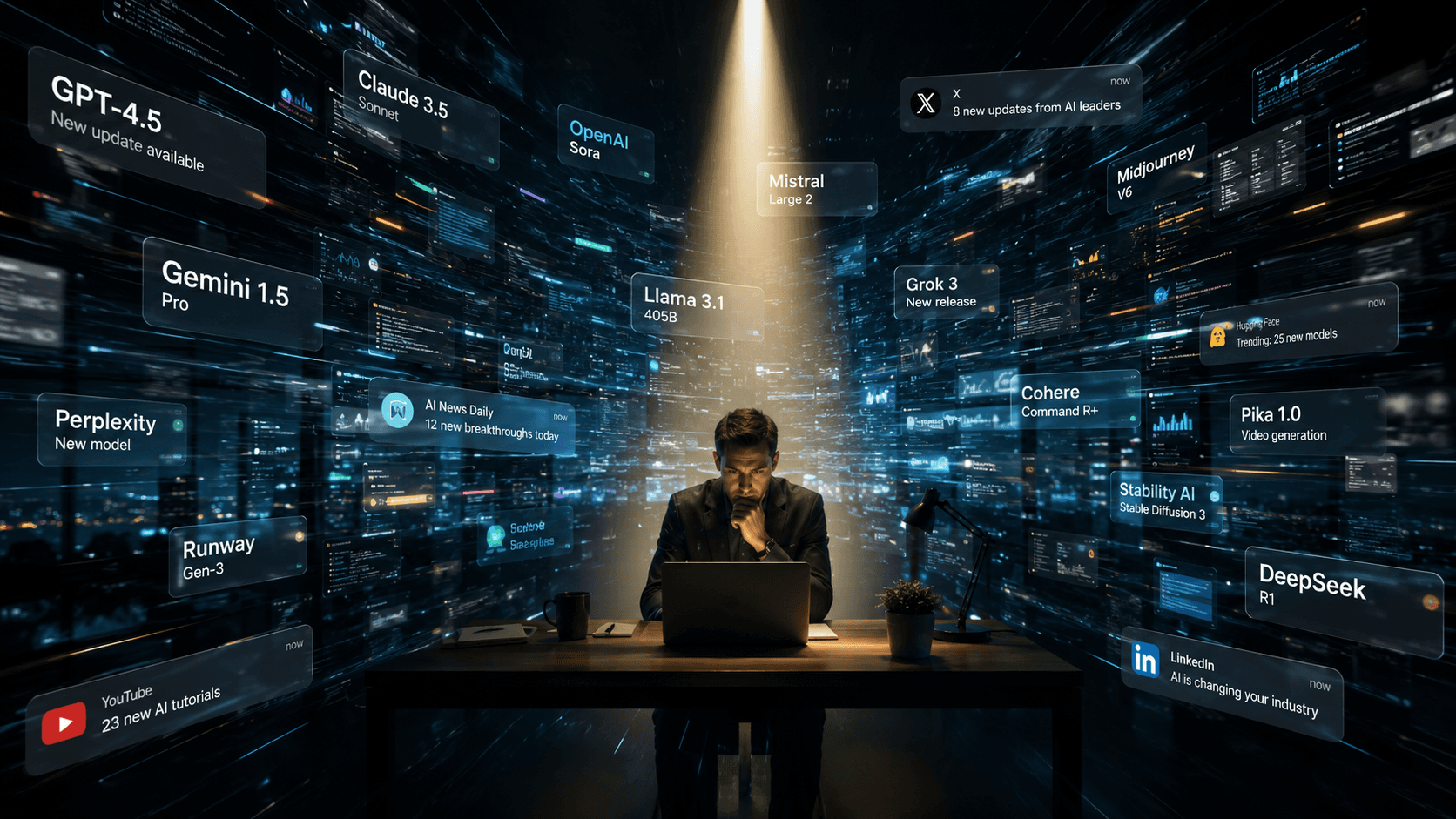
AI
Jun 30, 20265 min read
You Almost Need to Be Unemployed to Keep Up With AI
AI mutates in public — a tool you mastered in three weeks gets replaced over a weekend. But the real problem isn't intelligence, it's cognitive bandwidth. You don't need to know everything about AI to benefit enormously from it. Trying to is the fastest way to learn nothing deeply.
Last Tuesday, a product manager I know opened LinkedIn during a coffee break and saw three posts announcing “the most important AI release of the year.” By lunchtime, someone on X had already declared one of them obsolete. By evening, there was a new benchmark chart proving another model had quietly leapfrogged everything from the week before. He closed his laptop with the same exhausted expression people used to reserve for tax season or family WhatsApp groups.
You know that feeling, right? That strange low-grade panic that maybe the future is accelerating faster than your calendar can tolerate.
The uncomfortable truth is that modern AI progress has broken the normal rhythm of professional learning. In most industries, you could disappear for six months, come back, read a few reports, and still function competently. AI does not behave like that. It mutates in public. Entire workflows collapse in a weekend. A tool you spent three weeks mastering suddenly gets replaced by a startup founded by two people and a Notion page.
For working professionals, this creates a psychological trap that nobody talks about enough. The real problem is not intelligence. It is cognitive bandwidth.
A lawyer with two children, a manager buried in meetings, a founder trying to make payroll, an analyst answering Slack messages until midnight, none of these people are “behind” because they lack curiosity. They are behind because the human brain was not designed to process a new technological paradigm every 72 hours while also replying to emails, attending quarterly reviews, and pretending to enjoy networking events.
And yet the internet keeps selling this fantasy that everyone should somehow stay perfectly current.
Watch enough AI content online and you begin to feel like competence itself has become a full-time job. One creator tells you to learn agents. Another says agents are dead and you should focus on MCP servers. Then someone else insists the future belongs to local models, while another person claims vertical AI applications will eat everything. Every week arrives with a new acronym, a new framework, a new existential warning.
People are not drowning because AI is too hard. They are drowning because the firehose never stops.
A few years ago, expertise had a shelf life. Now it feels like rented property.
I spoke recently with a senior marketing executive at a global company who confessed something quietly over dinner. He said he spends nearly two hours every night consuming AI content, not because he enjoys it, but because he is terrified of becoming professionally irrelevant. Think about that for a second. A successful executive with twenty years of experience now feels like a student desperately cramming before an exam that never arrives.
That anxiety is spreading everywhere.
Junior employees think they are already obsolete. Mid-career professionals feel trapped between responsibility and reinvention. Even highly technical people privately admit they cannot keep up anymore. The pace has exceeded the emotional processing speed of modern work culture.
But here is the paradox nobody wants to say out loud: you do not need to know everything about AI to benefit enormously from AI.
In fact, trying to know everything is probably the fastest way to learn nothing deeply.
The people adapting best right now are not the ones consuming the most information. They are the ones building selective attention. They understand that AI literacy is starting to resemble physical fitness. Consistency beats intensity. Systems beat bursts of motivation. You do not get healthy by trying every workout on YouTube in the same week. You get healthy by doing a few useful things repeatedly until they become part of your identity.
AI learning works the same way.
A software engineer I know created a personal rule that changed everything for him. He ignores 90% of AI news unless it directly affects one of three things: how he writes code, how he communicates, or how he makes money. That single filter eliminated most of his anxiety overnight. Instead of chasing novelty, he started compounding capability.
That distinction matters more than people realize.
The AI economy currently rewards applied understanding far more than theoretical awareness. Nobody cares if you watched twelve videos about autonomous agents if you still cannot automate a weekly report. Nobody is giving promotions for “staying updated.” Organizations reward leverage, not spectatorship.
And there is another deeper psychological shift happening underneath all this.
For years, ambitious professionals built identity around accumulated knowledge. The smartest person in the room was usually the one who remembered the most information. AI destabilizes that identity structure because information itself is becoming abundant and instantly accessible. The new advantage is not memorization. It is adaptation. Judgment. Taste. Knowing what to ignore.
That last part may become the defining professional skill of this decade.
Because every technological revolution creates two classes of people: those who confuse movement with progress, and those who quietly build durable systems while everyone else panics.
The second group usually wins.
So if you feel overwhelmed by AI right now, you are not failing some secret intelligence test. You are reacting normally to an abnormal rate of change. The solution is not to consume more. It is to become strategically selective.
Here is what that looks like in practice.
Pick one domain where AI directly affects your economic value. Just one. If you are a designer, focus there. If you are in sales, focus there. If you manage teams, study how AI changes communication, operations, and decision-making. Ignore the rest for now. The internet will make this feel irresponsible. It is not. It is survival.
Then build tiny rituals instead of giant ambitions.
Twenty focused minutes every morning beats five frantic hours on Sunday. One real workflow automation beats consuming fifty “Top 10 AI Tools” posts. One experiment you actually deploy changes your career faster than ten bookmarked tutorials you never revisit.
Most importantly, stop measuring yourself against people whose full-time job is talking about AI.
Of course they know every model release. Of course they tested six new tools this week. A fitness influencer probably spends more time in the gym than you do too. That does not mean you are unhealthy. It means they are operating under different incentives.
You do not need to become an AI commentator. You need to become AI-capable.
Those are completely different goals.
And honestly, the professionals who thrive over the next five years will probably not be the loudest people online. They will be the quiet operators who learned how to integrate AI calmly into real work while everyone else was busy performing expertise for social media.
The future may belong to people who can stay technologically current without becoming psychologically consumed.
I'm curious how others are navigating this. Have you found a sustainable way to learn AI while still managing an actual life and career? Or does it still feel like drinking from a firehose every day?